There’s a quiet lie sitting inside a lot of growing businesses.
“We have a project management tool.”
And technically? That’s true.
There’s a board. There are tasks. Someone updates statuses (sometimes). Reports can be pulled (if you really need them). It looks organised.
But here’s the uncomfortable question:
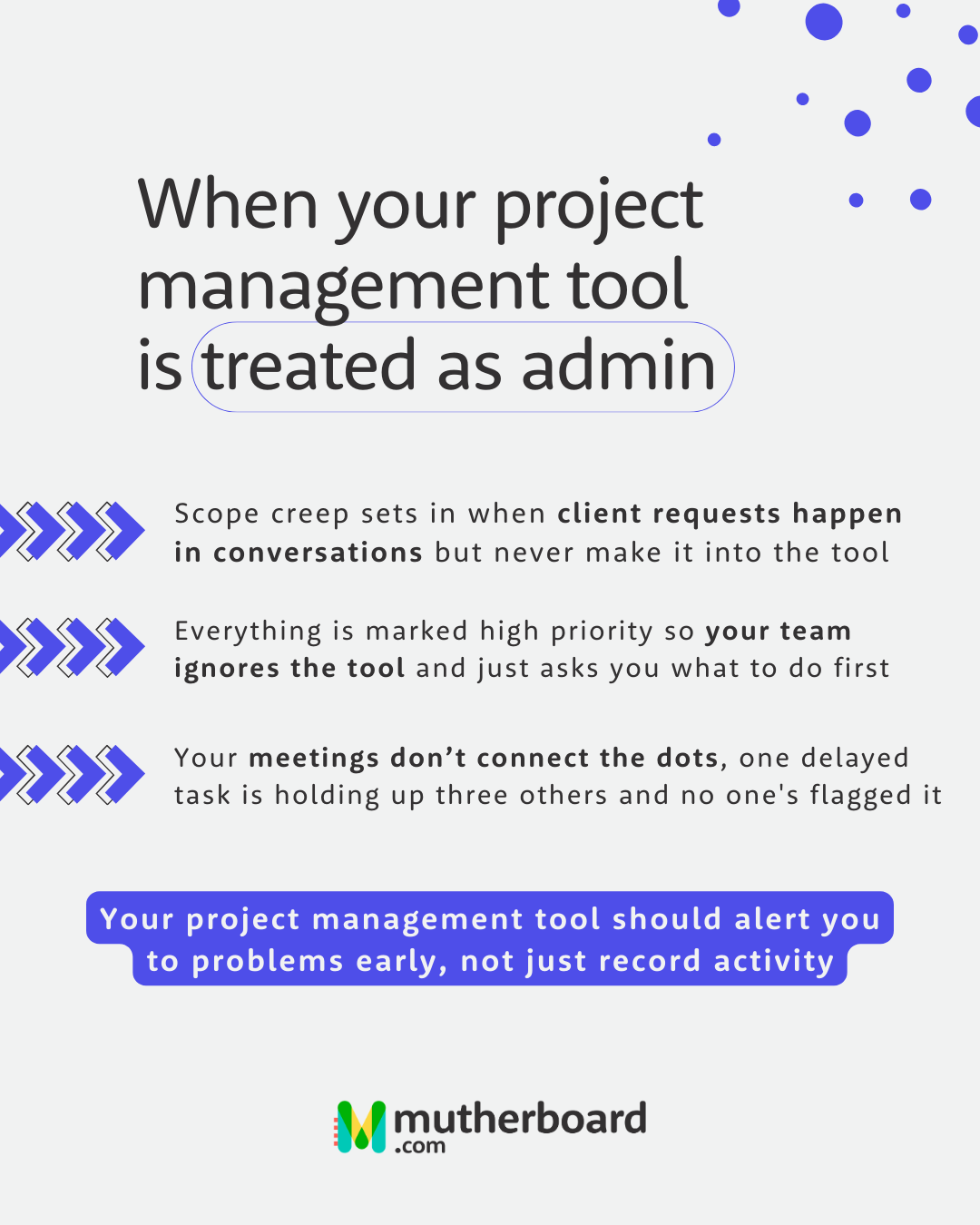
Is your tool actually managing projects — or is it just recording activity?
Because there’s a big difference.
The Slow Drift Into Admin Mode
Most teams don’t decide to treat their system like admin. It happens gradually.
A client makes a request in a call.
You say yes (because of course you do).
It lives in your head.
Maybe in Slack.
Maybe in an email.
Maybe nowhere.
It never makes it into the tool.
Multiply that by 20 conversations and suddenly your “official” plan and the real scope are living in two different universes.
That’s where scope creep doesn’t feel dramatic — it just quietly becomes normal.
Then there’s priority chaos.
If everything is marked “High,” your team stops trusting the board.
They start asking you directly: “What should I do first?”
Now you’ve become the human notification system.
The tool isn’t driving the work.
You are.
And that works… until it doesn’t.
The Hidden Cost of “We’ll Catch It in the Meeting”
Here’s another pattern we see all the time:
Meetings become the place where the real dots get connected.
Someone says, “Oh wait — if that’s delayed, then this can’t go live.”
Cue awkward silence.
Because the dependency wasn’t flagged.
The knock-on effect wasn’t visible.
The risk wasn’t surfaced early.
Not because your team isn’t capable.
But because your system isn’t designed to think ahead.
If your project management tool only shows individual tasks without highlighting dependencies, capacity strain, and timeline impact, it’s functioning as a logbook — not a management layer.
And logbooks don’t prevent fires. They document them.
A Project Tool Should Be Slightly Annoying (In a Good Way)
A properly built system should:
-
Flag when capacity is overloaded before burnout hits
-
Surface when a delayed task affects three others
-
Show when scope increases without budget or timeline adjustments
-
Alert you when timelines shift beyond agreed tolerances
-
Highlight patterns across projects (not just within one)
It should make it hard to ignore risk.
It should make “everything is urgent” mathematically impossible.
It should reduce the number of status meetings you need — because the truth is already visible.
If your system feels passive, it probably hasn’t been configured with enough intelligence behind it.
The Tool Isn’t the Problem
This is the part that surprises people.
It’s rarely the software.
Whether you’re using monday.com, ClickUp, Asana, Jira — most platforms are powerful enough. The issue is how they’ve been implemented.
Most setups are:
-
Built around tasks instead of outcomes
-
Configured without real dependency logic
-
Disconnected from financial tracking
-
Not integrated with CRM or resource planning tools
-
Missing automation that could remove 30% of manual admin
So the tool becomes a digital filing cabinet.
Useful. But reactive.
Visibility Changes Behaviour
When a system is properly integrated and automated, something subtle shifts.
Scope changes get logged because they trigger impact alerts.
Priorities stabilise because capacity is visible.
Teams stop asking what to do first because the board reflects reality.
Leaders stop relying on gut feel because the data tells a clearer story.
And the emotional load reduces.
Less chasing.
Less firefighting.
Less “why didn’t we see this coming?”
More proactive decisions.
More predictable delivery.
More breathing room.
Project Management Isn’t Admin — It’s Strategy
If your project tool is only being used to tick off completed tasks, you’re missing its most powerful function.
Project management, done properly, is an early warning system.
It’s a capacity radar.
A scope control layer.
A financial predictor.
A dependency map.
It shouldn’t just record what happened.
It should tell you what’s about to happen.
That’s the difference between staying busy and scaling sustainably.
The Question Worth Asking
If you stepped away for two weeks, would your system:
-
Clearly show where risk is building?
-
Alert someone before a client is impacted?
-
Surface capacity strain before someone burns out?
-
Reflect real scope and priority without you interpreting it?
Or would everything grind to a halt because the tool depends on you to translate it?
That’s usually the real test.
Tools don’t create clarity on their own.
Design does. Integration does. Automation does. Visibility does.
If your project management system feels more like admin than strategy, it might not need replacing.
It might just need rethinking.
And that’s a far more powerful shift.