For years, spreadsheets have been the default tool for capacity planning.
They were familiar, flexible, and “good enough”… until they weren’t.
As teams grow, projects overlap, and margins tighten, spreadsheets start to show their cracks. Version control issues. Manual updates. Conflicting assumptions. Endless tabs that only one person truly understands. And suddenly, what was meant to bring clarity becomes the very thing creating uncertainty.
The reality is simple: modern capacity planning needs modern tools.
The Spreadsheet Problem No One Talks About
Spreadsheets aren’t bad — they’re just not built for dynamic, real-time resourcing.
Most teams using spreadsheets for forecasting capacity struggle with the same issues:
-
Capacity data lives separately from project plans
-
Leave and holidays are added manually (or forgotten altogether)
-
Billable vs non-billable work isn’t always clear
-
Forecasts go out of date the moment something changes
-
Commercial impact is calculated after the fact, not as decisions are made
The result? Leaders are forced to plan based on estimates, not reality. Decisions feel reactive instead of confident. And resource conversations become stressful far more often than they should.
What Capacity Planning Should Look Like
At its core, capacity planning is about answering a few critical questions:
-
Do we actually have the capacity to take on more work?
-
Are we using our people effectively?
-
Where are we over- or under-resourced?
-
What’s the commercial impact of our resourcing decisions?
To answer those questions properly, data needs to be connected, current, and easy to interpret.
That’s where tools like Projectworks (powered by mutherboard) change the game.
A Single, Connected View of Capacity
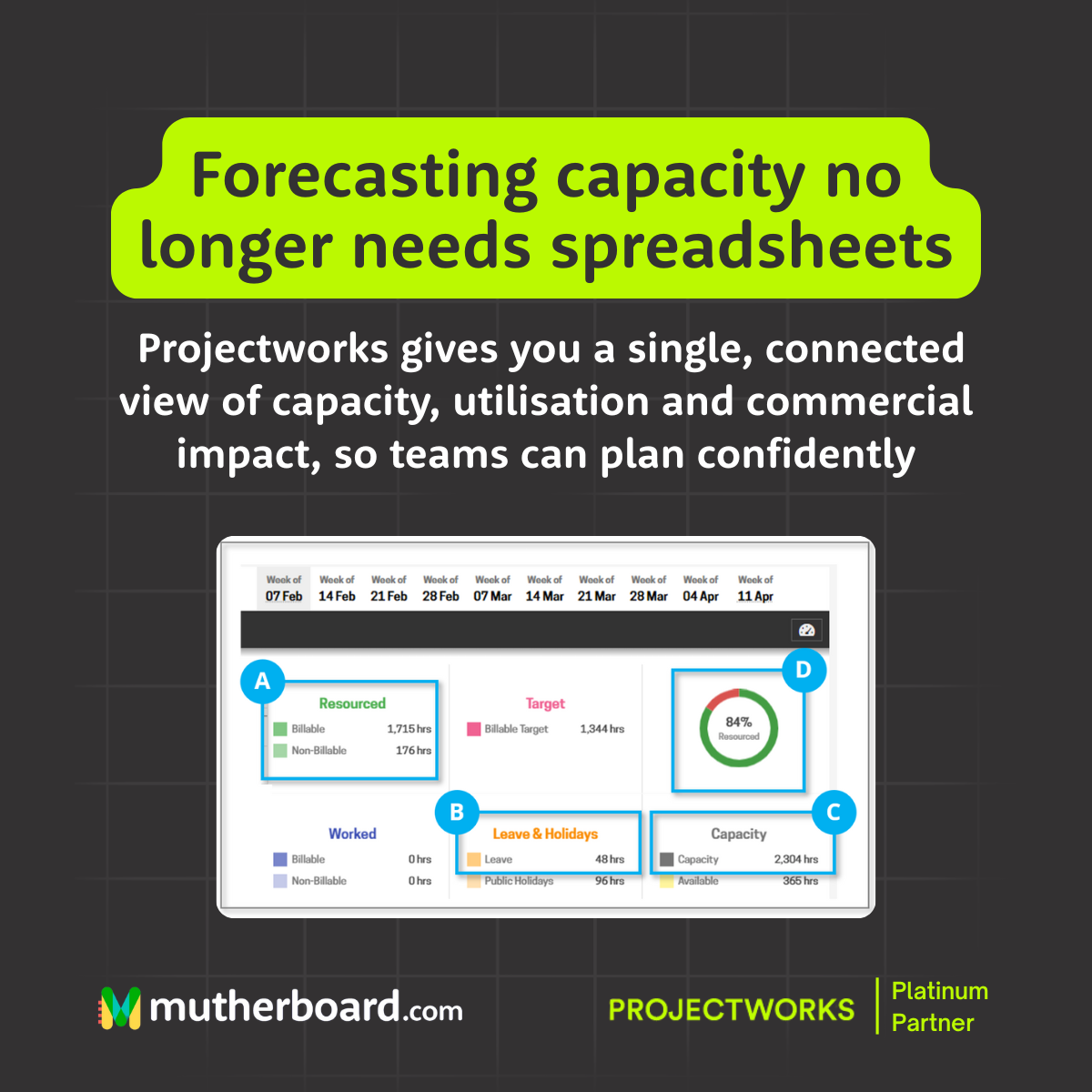
Projectworks gives teams a unified view of:
-
Resourced hours (billable and non-billable)
-
Worked hours
-
Leave and public holidays
-
Available capacity
-
Utilisation targets and performance
-
Commercial impact
Instead of pulling data from multiple sources and stitching it together in a spreadsheet, everything lives in one place — updated in real time.
This means when a project shifts, a deadline moves, or someone goes on leave, your capacity forecast updates automatically. No rework. No broken formulas. No surprises at month-end.
From Guesswork to Confident Planning
When capacity, utilisation, and commercial data are connected, teams can:
-
Spot resourcing risks before they become problems
-
Plan future work with confidence
-
Balance workloads more effectively
-
Protect margins while scaling delivery
-
Make informed decisions quickly
It also changes the tone of resourcing conversations. Instead of debating whose spreadsheet is “right,” teams can focus on what to do next.
Where mutherboard Fits In
At mutherboard, we work with growing, delivery-focused teams who are tired of duct-taping systems together. As a Projectworks Platinum Partner, we help businesses implement, integrate, and optimise Projectworks so capacity planning becomes a strength — not a stress point.
We don’t just set up the tool. We help teams:
-
Design resourcing models that reflect how they actually work
-
Connect Projectworks with the rest of their tech stack
-
Build processes that scale as the business grows
-
Turn capacity data into actionable insights
The goal isn’t just better forecasts.
It’s better decisions, healthier teams, and more predictable growth.
Spreadsheets had their moment. But capacity planning has moved on.
If your forecasts rely on manual updates, disconnected data, or best guesses, you’re not planning — you’re hoping. Tools like Projectworks, combined with the right implementation and strategy, give teams the clarity they need to plan confidently and grow sustainably.
And once you experience capacity planning without spreadsheets… there’s no going back.