There’s a quiet frustration showing up in a lot of teams right now.
They bought the AI tools. They turned on the features. They expected transformation.
And instead?
Things feel… about the same.
The issue usually isn’t the AI.
It’s where teams are trying to use it.
AI isn’t a replacement for structure. It’s an amplifier of it. When you drop AI into unclear, shifting, or broken workflows, you don’t get efficiency — you get faster confusion.
Let’s talk about where AI genuinely adds value inside structured workflows, and just as importantly, where it doesn’t.
Where AI Actually Works
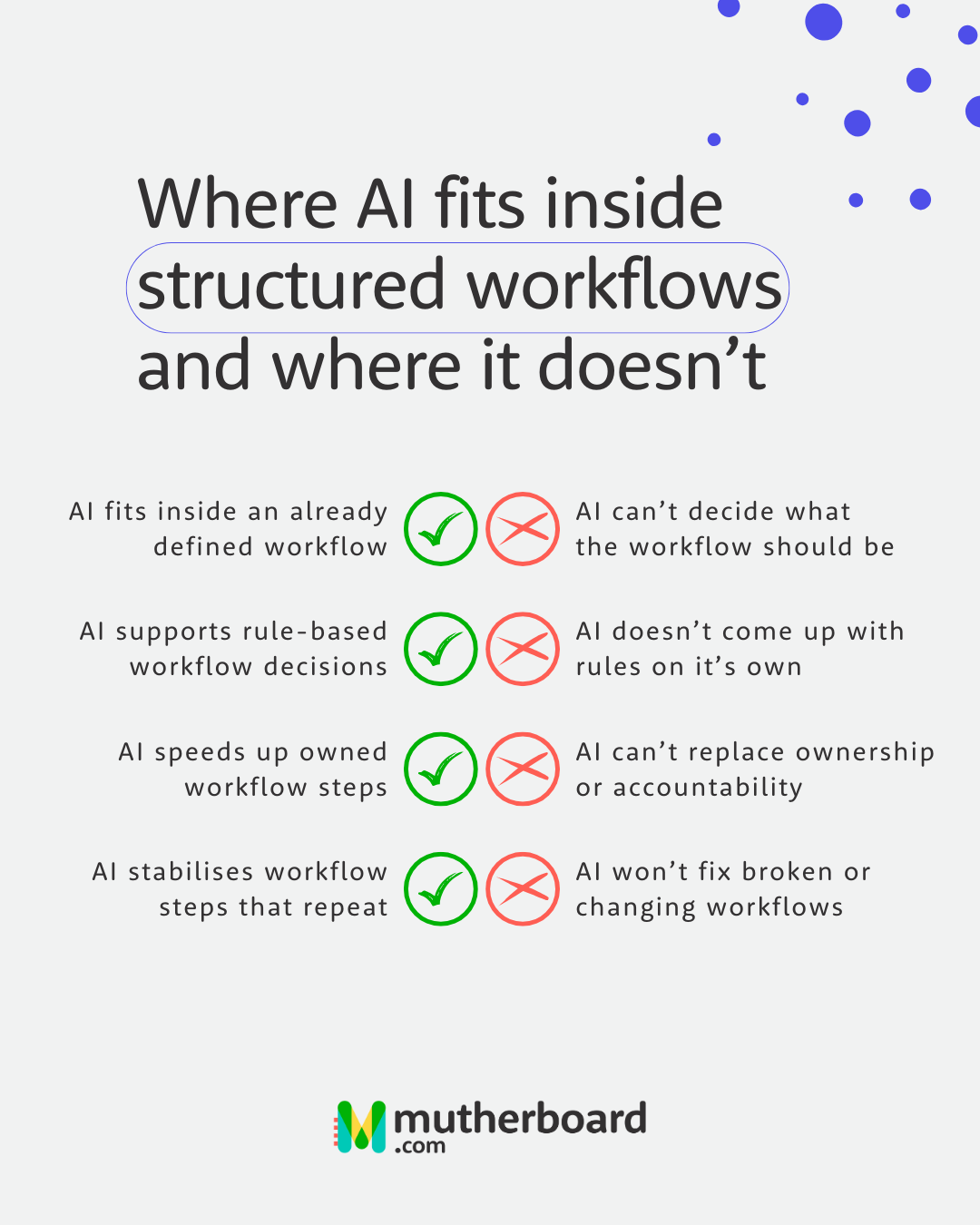
1. AI fits inside an already defined workflow
AI performs best when the workflow already exists and is understood by the people using it.
If a process has clear stages, owners, inputs, and outputs, AI can step in and help speed things up — drafting updates, summarising data, classifying information, or triggering next steps.
But if the process itself is vague ("we’ll figure it out as we go"), AI has nothing solid to support.
Think of AI as a power tool. It doesn’t design the house — it helps you build faster once the blueprint exists.
2. AI supports rule-based decisions
AI is excellent at applying rules consistently.
If X happens, do Y. If a task meets these conditions, route it here. If capacity drops below a threshold, flag it.
This is where AI removes friction and human inconsistency. It doesn’t get tired. It doesn’t forget. It doesn’t apply rules differently on a Friday afternoon.
However, the rules must already exist.
AI won’t decide what matters most to your business. It won’t define priorities, escalation paths, or trade-offs. Those are leadership decisions.
3. AI speeds up owned workflow steps
One of AI’s biggest strengths is acceleration.
It can:
-
Draft status updates
-
Summarise meetings
-
Pre-fill documentation
-
Suggest next actions
-
Surface risks earlier
But notice the key word here: owned.
AI works best when a human still owns the outcome. The AI supports the step — it doesn’t replace responsibility for it.
When ownership is clear, AI becomes a multiplier instead of a liability.
4. AI stabilises repeatable processes
Repetition is where AI shines.
The more often a step repeats, the more value AI can add by standardising outputs and reducing variation.
This is especially powerful in:
AI helps teams stay consistent, even as workload increases.
Where AI Doesn’t Work (and Why That’s Okay)
1. AI can’t decide what the workflow should be
AI won’t tell you how your business should run.
It doesn’t understand your culture, risk tolerance, or strategic goals. It can generate suggestions, but it can’t make accountable decisions about how work should flow.
If teams skip the hard thinking and hope AI will “figure it out,” they usually end up with brittle, confusing processes that nobody trusts.
2. AI doesn’t invent rules on its own
AI applies logic — it doesn’t define it.
If rules aren’t documented, aligned, and agreed on, AI will either behave unpredictably or reinforce bad habits faster.
This is why governance, documentation, and clarity matter more — not less — in AI-enabled teams.
3. AI can’t replace ownership or accountability
This is the most important limitation.
AI can assist. It can recommend. It can flag.
But it can’t be accountable.
When ownership is unclear, AI doesn’t fix the problem — it exposes it. Missed deadlines, unclear priorities, and dropped handovers still land on people.
Strong workflows make ownership visible. AI simply helps those owners move faster.
4. AI won’t fix broken or constantly changing workflows
If your process changes every week, AI won’t stabilise it.
If teams don’t agree on how work flows today, AI will just automate disagreement.
Before adding AI, workflows need at least a baseline level of stability. That doesn’t mean perfection — but it does mean alignment.
The Real Opportunity: Structure First, AI Second
The most successful AI implementations we see all follow the same pattern:
-
Clarify how work actually flows
-
Assign ownership at every step
-
Define rules and decision points
-
Identify repetition and friction
-
Then layer AI in deliberately
AI isn’t the strategy. It’s the accelerator.
And when used this way, it delivers real value — not hype.
Why This Matters Now
As AI becomes embedded into tools like project management platforms, resource planning systems, and operational software, the gap between structured and unstructured teams will widen.
Teams with clarity will move faster. Teams without it will feel left behind — even with the same tools.
The question isn’t whether to use AI.
It’s whether your workflows are ready for it.
At mutherboard, this is exactly where we focus: helping teams define, stabilise, and integrate workflows before layering in AI — so the technology actually works for the people using it.
Because AI doesn’t replace good operations.
It rewards them.